



Medical Dosimetry
Prerequisite coursework
Questions? Please email the program at mdprogram@uwlax.edu for assistance
All prerequisite (prereq) courses must be completed prior to the program's application deadline; without exception. Completing courses during the spring or summer semester before intending to start the program is not acceptable. Comparable courses from regionally accredited institutions are acceptable. No prerequisite coursework with a grade below C will be accepted. Due to the competitive admissions process, applicants with C or lower math and physics grades may not be moved to the interview phase as this is an indicator of weak preparation for success in the medical dosimetry program.
The program does not have a "statute of limitations" on prerequisite courses. Applicants will be considered to have met the prerequisites even if they were taken many years ago, however, with the program's academic rigor the applicant's current academic aptitude is considered. One means to demonstrate current academic aptitude is the applicant's performance in courses taken over the past four years. Thus, it may be advantageous to have completed some courses, potentially including prerequisites in the past four years.
- (6-8 cr) Human Anatomy & Physiology - two semester sequence with labs; or equivalent
- (6-8 cr) Physics – two semester sequence; or equivalent
- (3-4 cr) Pre-Calculus; or College Algebra + Trigonometry; or equivalent
- (3-4 cr) Biology; or equivalent
- (1-3 cr) Medical Terminology; or equivalent
For questions regarding prereq coursework, or a review of a particular course to determine if it satisfies the program's course requirement, please email the program at mdprogram@uwlax.edu. Please include the school at which the course was completed, the course number, and a course description in your email.
Prospective students should review the technical standards for the profession prior to applying.
Technical standards for Medical Dosimetrists:
- Demonstrate oral and written proficiency in the English language, including the ability to read, interpret and apply written instructions (treatment charts, notes, records, technical publications, equipment manuals, etc.).
- Communicate effectively with faculty, fellow students, physicians, and all members of the health care team.
- Maintain intellectual and emotional stability and maturity under stress while also maintaining appropriate performance standards.
- Lift 30 pounds of weight (treatment cones, blocks for treatment, ancillary aids), including the ability to lift such heavy items overhead up to 6 feet.
- Push a standard wheelchair from the waiting room to the treatment room, and move immobile patients from a stretcher to a treatment or diagnostic table.
- Possess sufficient audio acuity to perceive and interpret audio signals from equipment during treatment or treatment planning.
- Possess sufficient visual acuity--corrected to 20/20--to observe patients and equipment operation during treatment or treatment planning; have adequate perception of depth and color; and be able to view computer monitors for extended periods.
- Grasp complex three-dimensional spatial relationships.
- Have sufficient manual dexterity to carry out all aspects of medical dosimetry procedures.
- Distinguish color and shades of gray.
- Use a computer and a mouse and endure 6 - 10 hour clinical days consisting of a minimum 6 - 8 hours sitting in front of a computer; typically in low light situations.
- Endure numerous hours of online didactic instruction sitting in front of a computer.
News
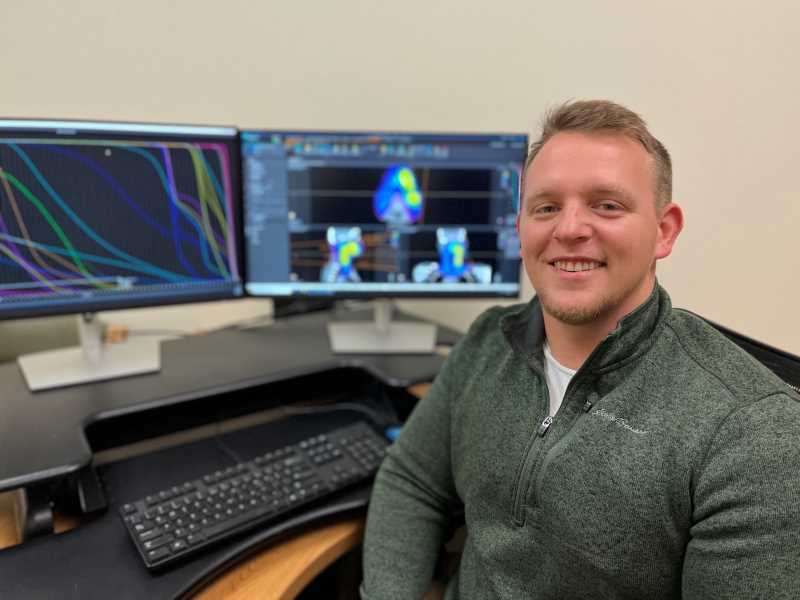 Life lessons from cancer care
Posted 1:56 p.m. Thursday, Feb. 8, 2024
Alumnus Jacob Wudtke shares wisdom from caring for cancer patients
Read more about Life lessons from cancer care
Life lessons from cancer care
Posted 1:56 p.m. Thursday, Feb. 8, 2024
Alumnus Jacob Wudtke shares wisdom from caring for cancer patients
Read more about Life lessons from cancer care
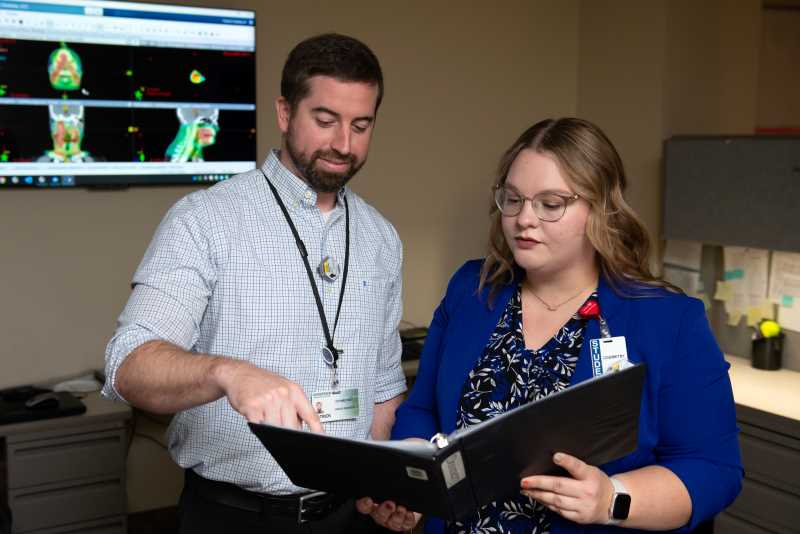 Fighting cancer with calculations
Posted 8 a.m. Tuesday, Oct. 25, 2022
A mystery profession to most, medical dosimetrists target cancer from behind the scenes
Read more about Fighting cancer with calculations
Fighting cancer with calculations
Posted 8 a.m. Tuesday, Oct. 25, 2022
A mystery profession to most, medical dosimetrists target cancer from behind the scenes
Read more about Fighting cancer with calculations
 Medical Dosimetry Program
Posted 8 a.m. Tuesday, Nov. 24, 2020
UW-La Crosse students recognize clinical instructors
Read more about Medical Dosimetry Program
Medical Dosimetry Program
Posted 8 a.m. Tuesday, Nov. 24, 2020
UW-La Crosse students recognize clinical instructors
Read more about Medical Dosimetry Program